Here’s how food brands boost their online visibility.
FMCG SEO—that is, search engine optimization for fast-moving consumer goods—is an underrated growth channel for many food brands.
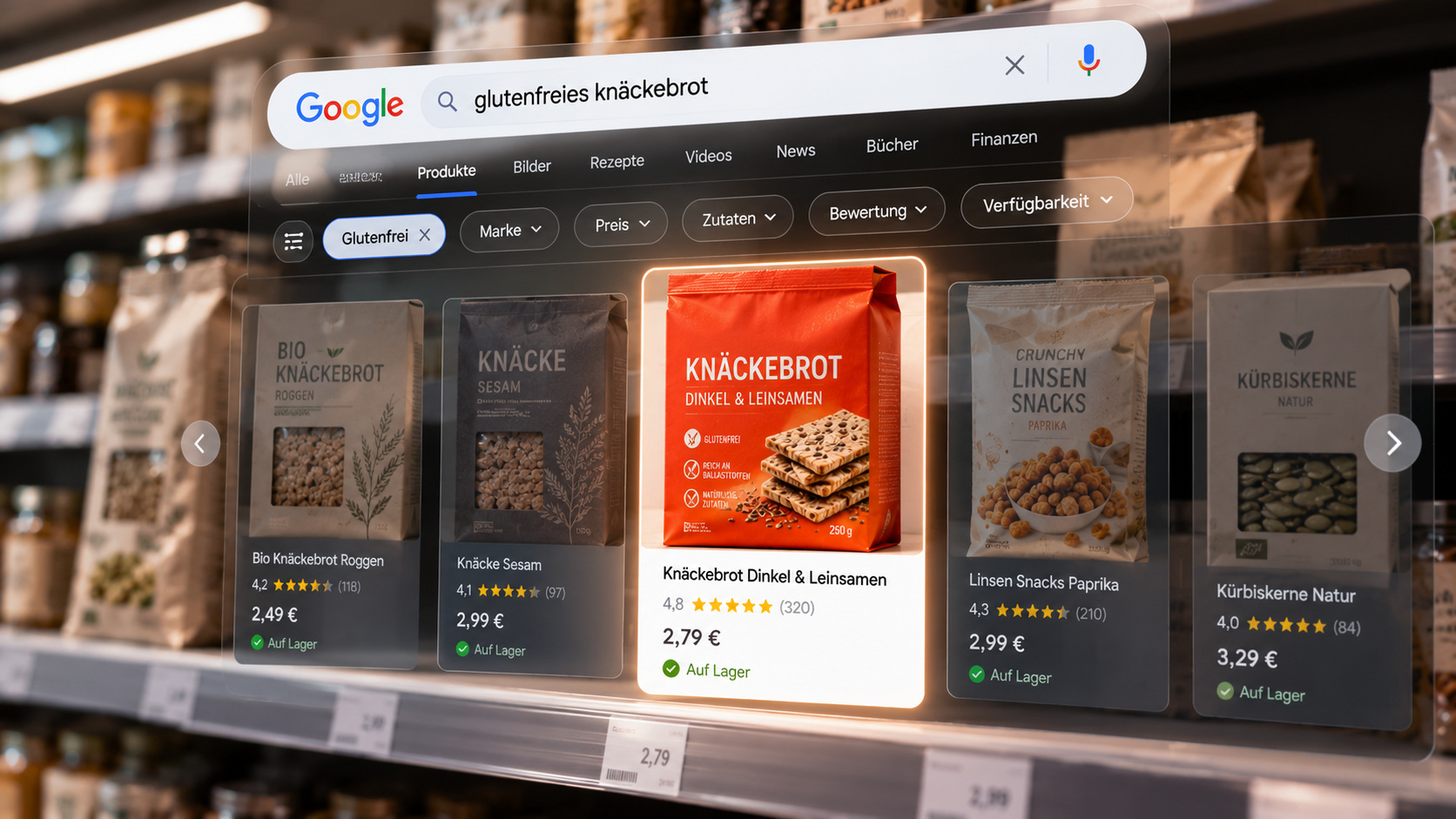
Many brands prioritize listing fees, retail marketing, and promotional campaigns, while relatively little is invested in organic visibility. Yet today, many purchasing decisions begin with a search query—whether for “gluten-free crispbread,” “vegan snacks,” or “sugar-free meal plan.” Those who aren’t visible at these moments lose potential buyers to competitors before shoppers even step into the aisle.
Organic search engine optimization for fast-moving consumer goods is no longer an optional channel. It is a strategic pillar that directly drives brand awareness and sales. This guide explains which strategies really work, what food brands need to consider from a technical standpoint, and why brand identity and digital visibility are more closely linked than many brand managers realize. It concludes with a concrete 90-day plan.
German consumers primarily search for needs-based and category-related terms in the food sector, not brand names. Terms such as “gluten-free,” “lactose-free,” “vegan snacks,” or “meal plan” dominate the upper part of the purchase funnel. Brand terms only come into play when there is either a clear intention to purchase or the brand is already familiar to the consumer.
Category terms take precedence over brand terms.
For any keyword strategy, this means that if you optimize exclusively for your own brand name, you’ll miss out on the majority of search volume. A shopper first searches for “gluten-free crispbread,” clicks through product pages, and then decides on a specific brand. If you don’t show up during this early research phase, you simply don’t exist for that buyer.
Short purchasing cycles and a heavy reliance on trade.
FMCG products are rarely purchased directly from the manufacturer. Purchases are made at grocery stores, on marketplaces, or at online supermarkets. This creates a structural visibility gap: The brand’s own website often plays no direct role in the transactional purchase moment.
Nevertheless, the brand website is indispensable for research, building trust, and fostering brand loyalty. Successful SEO for fast-moving consumer goods must therefore simultaneously target the brand’s own website, retailer partner sites, and marketplaces. This requires a true omnichannel approach—not just an optimized homepage.
Websites with large product catalogs quickly generate thousands of URL variations through filter functions. Filtering by flavor, package size, or ingredient intolerance sounds like a convenient feature for users, but it’s problematic from a crawling perspective. Improperly configured faceted navigation leads to crawl bloat, internal duplicates, and conflicting signals to search engines.
Effectively manage faceted navigation and duplicate content.
The solution: Facets with no real search value are kept out of the index using `noindex`; important landing pages are assigned correct canonical tags; and internal linking consistently points to the preferred URL. Only facet pages that are actually relevant to highly sought-after subcategories should remain indexable. An example of clean internal linking: A category page titled “Vegan Snacks” links to the corresponding product overview using the anchor text “Discover vegan snacks,” ensuring that link signals flow specifically to where they support rankings.
Structured Data for Product Pages: What Really Matters.
The Product schema, Offer schema, and AggregateRating are established best practices for every product page. The Product schema represents the product’s identity; Offer includes price, currency, and availability; and AggregateRating should only be included if genuine reviews are visible on the page. The structured data markup must always match the visible page content.
In Germany, the General Product Safety Regulation (GPSR) also applies: Product pages must prominently display safety information and the manufacturer’s contact details, not only in the markup but directly within the product listing. This should be distinguished from the General Data Protection Regulation (GDPR), which governs the handling of personal data and sets separate requirements for privacy policies and consent mechanisms. JSON-LD is the implementation format recommended by Google for structured data; the markup must be included in the server-side HTML so that crawlers and Google Merchant Center can reliably read it.
Mobile Performance as a Ranking Factor.
A large portion of the research conducted before purchasing consumer goods takes place on mobile devices. Slow loading times and poor Core Web Vitals not only reduce the likelihood of a purchase but also directly impact organic visibility. Since Google uses mobile-first indexing, speed and user experience on mobile devices directly influence rankings. This is not a minor detail but a fundamental quality signal.
Local SEO for brick-and-mortar retail networks.
For brands with a brick-and-mortar presence, it’s also worth taking a look at local SEO. Well-maintained listings on Google Business Profile, structured address data—known as NAP data (name, address, and phone number consistent across all platforms)—and location-specific landing pages help reach consumers near a retail location. Local search queries such as “buy organic yogurt in Berlin” or “gluten-free products nearby” are becoming increasingly important; businesses that maintain a consistent presence with accurate location data here can close a real visibility gap in brick-and-mortar retail.
The strongest SEO results in the consumer goods sector almost always come from consistent optimization of product detail pages and category pages. A case study from the German-speaking market (Adamicus) demonstrates that a well-thought-out keyword strategy for product pages can increase online revenue by up to 309 percent and raise the share of revenue attributable to SEO to 25 percent of total revenue. This is a documented individual case study; comparable results have been repeatedly described in other case studies, although the specific figures vary depending on the initial situation.
Keyword-driven product pages as a measurable revenue driver.
A proven title template for product pages is: [Brand] + [Product Type] + [Key Feature] + [Quantity], for example, “Brand Name Gluten-Free Spelt Crispbread 200 g.” What must not be missing from an optimized product page:
- Title including brand, product type, and key features (quantity, flavor, characteristics)
- Informative product description with relevant category terms
- FAQ Section on Ingredients, Tolerance, Storage, and Use
- Reviews, trust signals, and clean internal linking to category pages
PIM as a prerequisite for consistent visibility.
A Product Information Management (PIM) system serves as the central database for all channels. Product data, which is first maintained in a complete and structured manner in the PIM, is then consistently available for your own website, retail partners, marketplaces, and Google Shopping. Without this central data repository, inconsistencies are bound to arise, leading to lower rankings, higher bounce rates, and a loss of trust.
Channel-specific attribute mapping ensures that required fields are filled in correctly for each platform. Price and availability data must be updated automatically and kept current on a daily basis, because outdated information in Google Merchant Center can directly lead to listings being excluded.
German consumers actively search for nutrition-related topics, recipes, food intolerances, and product features in the food sector. This search demand presents a real opportunity: Those who are visible in these search queries through category pages, how-to articles, and recipe formats can build brand awareness early on and generate organic traffic without direct advertising investment. It is crucial to structure this content thematically in a clear and organized manner and to consistently link it internally to the appropriate product pages.
Purchase-Related Content: The Journey from Research to Purchase Decision.
Purchase-related content has the strongest impact on sales. Product comparisons, use cases, and clearly structured “Which product is right for me?” formats convert organic traffic into actual purchases. Reviews and user-generated content have a dual effect: They improve organic rankings while simultaneously increasing the likelihood of a purchase by individual visitors.
For many consumer goods categories, Amazon has long since become the primary product search engine. Those who fail to optimize their listings there lose market share to private labels and competitors, often without even realizing it. Specifically, marketplace SEO for consumer goods means: titles that start with the brand, product type, quantity, and main keyword; precise bullet points highlighting purchase-relevant attributes; expanded brand content (A+ Content) to build brand loyalty; and active review management. Package sizes, variants, and quantity specifications must be clearly labeled because they are directly relevant to purchasing decisions for fast-moving products.
Amazon as a standalone search engine for grocery brands.
Omnichannel visibility means that product information, images, and the brand message are consistent and up-to-date at all times—whether on your own website, with retail partners, on marketplaces, or in Google Shopping. Inconsistent product data not only leads to lower rankings but also to a measurable loss of consumer trust. Google Merchant Center serves as the technical link between your own online store and the Shopping listings in Google Search; well-maintained feed data is not an optional extra here, but a minimum standard.
Brand search volume—that is, how often people search directly for a brand name—is a signal to Google that influences organic visibility over the long term. A brand that is instantly recognizable on the shelf, has a clear visual identity, and sticks in consumers’ minds is also more frequently searched for online. This connection between physical shelf impact and digital search behavior is no coincidence.
Why Strong Brands Are Found More Often Through Organic Search.
Strategically, therefore, brand identity, packaging design, and brand recognition must be considered from the very beginning. A strong brand image that immediately catches the eye on the shelf automatically benefits organic search as well. Investments in branding and packaging design are therefore not only sales-promoting measures at the point of sale, but also long-term building blocks of a well-thought-out FMCG SEO strategy.
Generative Search Systems as the New Reality of Visibility.
Search behavior is changing fundamentally. AI summaries on Google, as well as answers from systems like ChatGPT or Perplexity, provide direct information without users having to visit a website. For food brands, this means that those not mentioned in these AI-generated answers lose visibility, even if their own search rankings are solid. So-called Generative Engine Optimization is becoming increasingly important alongside traditional search engine optimization. This combination of traditional search engine optimization, relevant content, and visibility in AI systems is a key component of our search marketing strategy for food and FMCG brands.
What this specifically requires: structured, factually accurate content with clear FAQ sections, consistent use of product markup, consistent brand messaging across all channels, and authorized product information directly on the brand’s own website. Brands that structure their product data clearly and answer consumer questions directly are more likely to be picked up and recommended by AI systems. Nutritional information, ingredients, certifications, and usage instructions must be available in a machine-readable format.
Conclusion: Increase your visibility in 90 days with a clear FMCG SEO plan.
FMCG SEO isn’t a single lever—it’s a system. It consists of technical fundamentals, high-quality product data, funnel-aligned content, and cross-channel consistency. Those who start with a clear plan achieve measurable progress without spending their entire budget all at once.
Three priorities for the first 90 days:
Ensure a Solid Technical Foundation
Check canonical tags, implement structured data on product pages, optimize mobile load times, and fine-tune faceted navigation.
Optimize Product Pages for Search Intent
Conduct keyword research for all product categories, revise titles, descriptions, and FAQ sections, and consistently optimize internal linking to product pages.
Update PIM data for all channels
Complete product information in the central system, check feeds for Google Merchant Center and marketplaces for consistency, and automate price and availability data.
Sustainable organic visibility always depends on the strength of the brand itself. Investing in a clear brand identity and compelling packaging design automatically strengthens a brand’s digital visibility. The store shelf and the search engine speak the same language: clarity, recognition, and trust. In practice, brands that consistently leverage both channels often perform better than those that rely on only one of them.
With a targeted FMCG SEO plan and a strong brand image as a foundation, food brands can achieve organic visibility more quickly. Feel free to talk to the MILK. team about this.