Closed loop for everything?
Why does single-use packaging even still exist? Many environmentalists repeatedly direct their criticism at the industry that produces packaging that, from the consumer’s perspective, is often used for only a few seconds. Wouldn’t it make much more sense to return packaging that is still technically in perfect working order to the recycling loop?
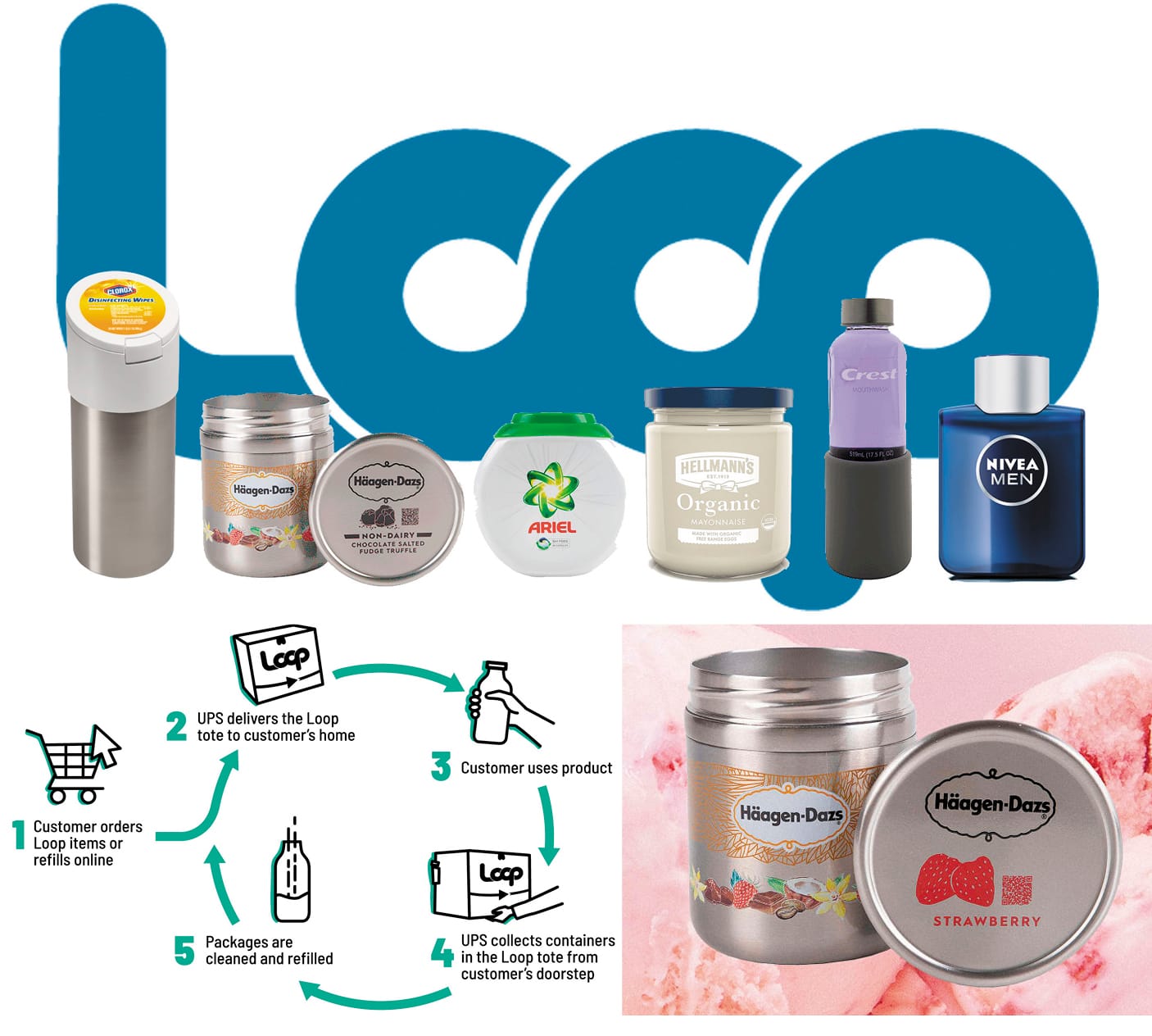
As part of a project called Loop, Procter & Gamble, Unilever, Nestlé, PepsiCo, Danone, Mars Petcare, Mondelēz International, and other consumer goods giants collaborated with the startup TerraCycle to develop a solution designed to reduce waste in the future. This involved a completely new way of shopping, in which reusable packaging played the leading role. Hundreds of items—from Tide laundry detergent to Pantene shampoo to Häagen-Dazs ice cream—were offered in reusable containers. After using the products, customers placed the empty containers in the Loop bag on their front doorstep to have them picked up, cleaned, refilled, and delivered back. In other words, the 21st-century milkman was set to save the world from single-use plastic.
After the initial pilot phases, however, disillusionment set in: While partners such as Tesco in the United Kingdom ended their trials after a year, and planned large-scale expansions with Carrefour in France and Walmart in the United States also stalled, the original online direct-delivery model was largely discontinued. The extremely high logistical complexity, expensive cleaning procedures, and subdued consumer demand have hindered a breakthrough in the mass market.
Instead of relying on widespread package delivery via delivery services, Loop now focuses primarily on niche solutions and selective partnerships with brick-and-mortar retailers and chain restaurants. The ambitious goal of sustainably revolutionizing global supermarket shopping thus remains, for the time being, an instructive but unfulfilled vision.
For a reusable system to work in the broader retail sector, we would have to move away from brand-specific individualism: Instead of each manufacturer using its own elaborate designer containers, we need standard formats that work across manufacturers, as already described in our “pool” scenario . Let’s imagine a supermarket where dry goods like rice, cereal, or laundry detergent are stocked on the shelves in uniform, stackable standard containers. Customers can simply return these to any deposit machine—regardless of where they were purchased. This drastically simplifies logistics, as the empty containers are collected directly at regional, specialized washing centers, cleaned, and delivered to the next local producer. Only when reusable packaging is just as convenient for consumers as plastic waste—and the infrastructure is shared by the entire industry—will sustainability trump convenience.