Is AI changing our tastes? Between Frankfurt green sauce and new traditions.
“Just using AI as a hook is not enough to build a sustainable gastronomy concept,” says James Ardinast. Nevertheless, artificial intelligence can provide strong support in the restaurant industry. But it’s not going to take his job, is it?

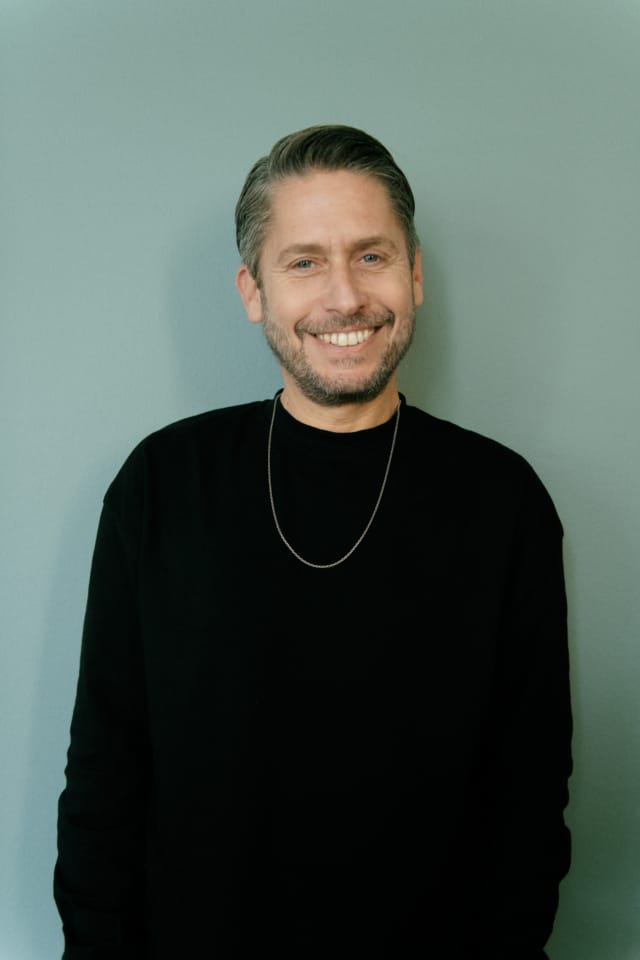
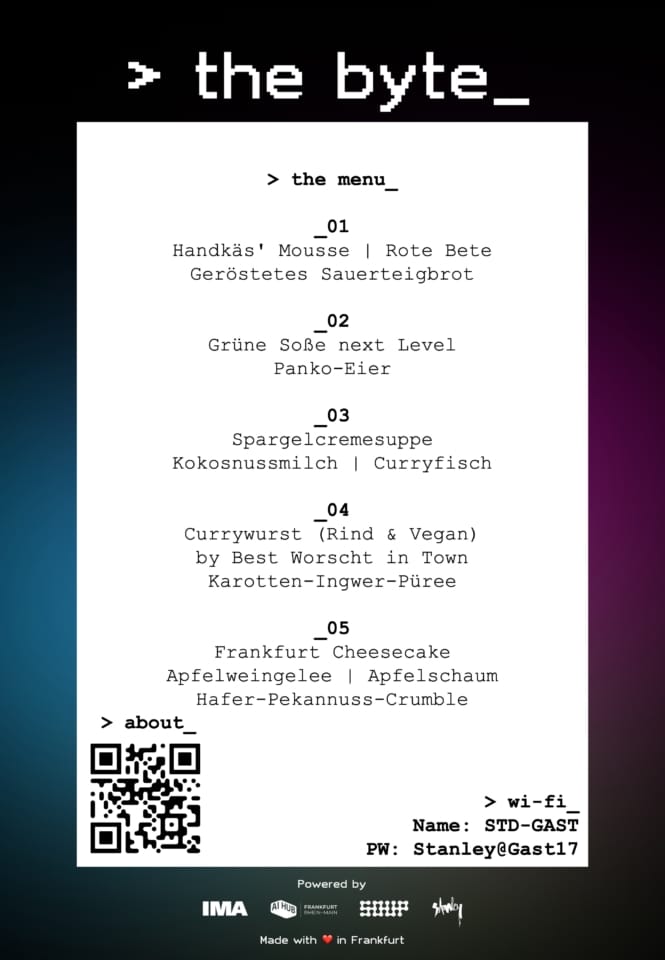
Can from the Innovation Lab spoke to James Ardinast – one of the FAZ’s 2026 Minds of the Year and co-founder of the IMA Clique – about the relationship between gastronomy and AI. The conversation was triggered by the byte, Germany’s first AI-based pop-up restaurant, which Ardinast launched with the AI consultants from statworx and Jonathan Speier.
Can: How did you come up with the idea of doing an AI dinner in the first place – and what was your original motivation behind it?
James: The first idea came about in the context of our festival. We held the S.O.U.P. Festival for the first time in 2021, then for the second time in 2023, and for the second edition we had an agency (statworx, editor’s note) with us that works in the AI sector. They were actually only supposed to give talks on AI and urban development, which brought us closer to the topic for the first time.
Then, at the end of 2022, there was suddenly this hype about ChatGPT. Suddenly everyone was talking about it, many people were worried about their jobs and wondered where it was all leading. We thought it would be exciting to do an AI dinner – without knowing exactly what it was supposed to be. The initial motivation was to make AI tangible: for our employees, but also for our guests – to arouse interest and allay any fears.
Have you never been afraid that AI could “take away” your job in the catering industry?
No, I personally was never afraid. I love the future, trends and futurology, so I found it more fascinating than threatening. I couldn’t imagine back then – and still can’t today – that AI would take my job.
Of course, the topic seems huge, and from the outside, “AI pop-up restaurant” sounded super big. But at the end of the day, we “only” learned to write the right prompts to generate recipes and ideas. The human part – taste, creativity, implementation, guest contact – remains central.
“I still can’t imagine AI taking my job in gastronomy.”
What did the AI actually do at the dinner – what did the menu and taste process look like?
We had ChatGPT develop recipes, for example with the task: take traditional Frankfurt cuisine and combine it with the ethnic influences of today’s Frankfurt population – make a kind of fusion cuisine out of it.
One of the results was our own “green sauce”. However, not with the classic seven herbs from the region, but with very exotic herbs. The surprising thing: It tasted good – really good. We cooked and tasted all the dishes beforehand; we felt that around 80 percent were “on point”, and we made adjustments to around 20 percent. For a machine without Tastebuds, that’s huge.
How did the guests experience the AI dinner – and what did you learn from their reactions?
It all tasted very good, but the expectations were different. Many had imagined an immersive tech spectacle under the heading of “AI dinner”: LED walls, moving chairs, totally futuristic rooms – such a very technoid world of experience.
Instead, they realized: AI is something that runs in the background, not a creature that sits there. We had AI-developed recipes, AI-generated art and music and a “voice” that guided you through the experience. For us, it all felt nice and rather smaller than it was sold in the press. The learning: just using “AI” as a hook is not enough to build a sustainable gastronomy concept.
In your opinion, how widespread is artificial intelligence in the hospitality industry today – is everyone working with ChatGPT?
Definitely not. Owner-managed individual restaurants in particular find it very difficult to deal with digitalization and AI. At events, you still see panel discussions about whether AI makes sense at all – you think to yourself: we’ve long since moved on.
On the other hand, we all have smartphones and have been using AI in our everyday lives for a long time, often without realizing it. Progressive companies in particular are consciously working with tools like ChatGPT. In places where people sit at computers a lot anyway – like in our agency – their use is now standard. In the kitchen, on the other hand, there is still a very traditional way of working.
It felt like 80 percent of the AI recipes were directly ‘on point’ – and that from a system that doesn’t have a single sense of taste.
What have you as a company learned specifically from working with AI – in the agency and in gastronomy?
The biggest learning is that AI makes work much more efficient. We reach our goal much faster, especially in the conception and research phase. In the past, certain recipe ideas or culinary directions would have taken days of research; today, with just a few prompts, I have a solid basis on which I can continue to work creatively.
Our chefs don’t all work directly with AI, but when it comes to thinking of culinary directions or menu ideas, it is a tremendous sparring partner. It doesn’t replace tasting or experience, but it speeds up the process from a vague idea to the first testable concept.
In your opinion, is AI itself becoming a tastemaker – can it change our tastes and traditions?
To a certain extent yes, especially for younger people who are perhaps more likely to start with AI than with cookbooks. AI can combine worlds of taste that we are not yet familiar with because it is constantly bringing together content that exists on the internet. At the same time, it learns from the past; it is only as good as what we feed it.
I see less danger in “the tradition itself” than in how people use AI – especially when it comes to information. In the food sector, I am very open to new traditions. Just because something is traditional today doesn’t mean that we can’t create something today that will be traditional in a hundred years’ time. AI can speed up processes here and bring old and new together in a new balance.
How does the use of and openness to AI differ between your agency and your restaurants?
In the agency, people sit at their computers almost all day, where the affinity for tools such as ChatGPT is much higher and people use them as a matter of course. In the restaurant business, the teams are more “on the front line”, i.e. in the operational business, without sitting in front of screens all the time. The kitchen is generally a very traditional area that traditionally has a harder time with new processes and digitalization. It’s clear to see that practically everyone in the office works with AI, but it’s still the exception in the catering industry.
“That doesn’t mean that we can’t start something today that will be a tradition in a hundred years’ time – AI can help with that.”
Can AI replace something like an in-house agency for small, owner-managed restaurants?
Absolutely. Many smaller companies cannot afford an external agency. AI can take on the role of an agency to a certain extent here: as a sparring partner for ideas, as help in structuring thoughts, formulating texts or developing campaigns and social media posts.
You give AI a clear briefing – goal, framework, target group – and receive suggestions that you can then filter and develop further according to your own taste. AI thus becomes a kind of “small in-house agency” that you can work with without having to worry about being replaced.
What can product developers take away from your AI work in the kitchen – for example, if they want to develop new products for the supermarket?
AI is an excellent creative sparring partner and “trend scanner”. When developing products, it is always about meeting needs and fulfilling certain framework conditions. AI can help to sort out these framework conditions and generate ideas within these limits.
It does not replace your own sense of trends or experience – especially if you have already worked on successful, trendy products. But all the trends out there are visible somewhere on the web; AI can bundle them together. If you have a good feel for markets yourself, you can assess very well what AI is suggesting and what is worth building on. This results in a relevant, testable product approach more quickly.
We would like to thank you for the interview and may organize an AI dinner ourselves in the near future…