Vegetables that taste like the sea
As with meat, a more sustainable treatment of animals and a critical observation of consumption quantities is also necessary for fish in order to maintain or restore an ecological balance, as fish stocks in the world’s oceans are threatened by overfishing.

Mit der 50:50 Wurst oder Gemüsecharcuterie haben wir Produkte vorgestellt, die zeigen, wie durch Gemüse typische Fleischgelüste nachhaltiger hergestellt werden könnten. Uns stellte sich die Frage, ob das auch mit Fisch funktionieren kann. Vielleicht nicht gleich mit einem saftigen Filet vom Steinbutt aber das was wir an Fisch lieben, z.B. die samtigen Texturen von rohem Fisch lassen sich auch mit Gemüse erzielen. Praktisch wäre es diese Texturen haltbar in Dosen verfügbar zu haben, denn das gelingt mit rohem Fisch nicht. Dosenfisch wiederum hat kräftige, intensive Aromen, die wir ebenfalls lieben, aber texturell sind Fischkonserven nicht mit rohem Fisch vergleichbar.
Velvety and strong
We could combine the best of both worlds: Velvety textures with strong flavors, always available in a can. Of course, there are already canned vegetables and canned fish – but there is no product that combines both worlds in this way. Canned fish has a special tradition. The
From vegetables to fish

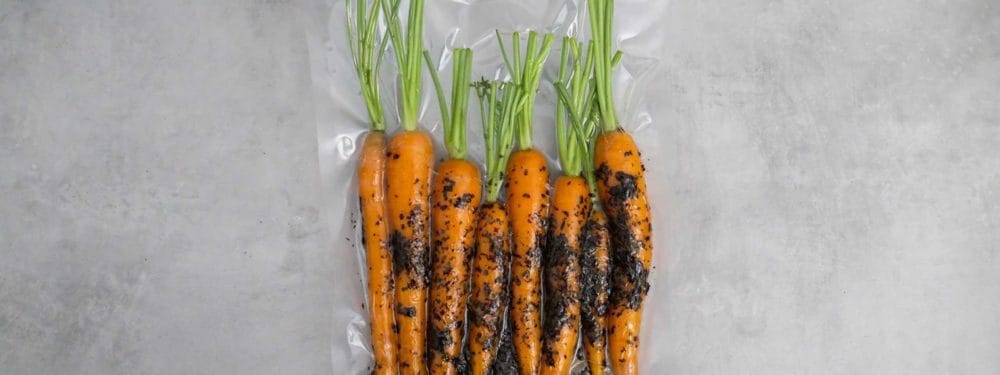
But before the packaging, we take care of the contents. We use colorful carrots, white radish, red radish, beet and yellow beet. We want to cook the root vegetables to give them a special texture and then refine them with a “fishy” taste. We wrap the vegetables individually and carefully in aluminum foil. We then bake the vegetables in a preheated oven at 180 degrees for an hour and then reduce the temperature to 80 degrees. Cook the vegetables for a further four hours and then leave to cool in the oven. Remove the aluminum foil and pat the vegetables dry. Cut some of the beet, carrot, radish and red radish into 4 mm thick slices using a vegetable slicer. We place the slices on the non-stick mats of the dehydrator and leave them to dry at 52 degrees for twelve hours. We also dry beets and carrots whole and hope to achieve a texture reminiscent of raw fish.
After twelve hours, the vegetable potato chips are dry; the controlled dehydration has given the whole beets and carrots a soft, leathery, almost rubbery texture without being tough.

Fish frit
Place the colored carrots in a pan and fill with cold rapeseed oil. Heat the oil to approx. 150 degrees. In this way we combine confit with fry. When confiting, the vegetables cook slowly, giving the oil a certain roasted flavor. We use this oil as an ingredient in our infusion.
The stock consists of the roasted vegetable oil, fish sauce, camelina oil, walnut oil and rice vinegar. Place the dry chips and the carrots confit in oil in this stock. The chips soak up the broth over the next few days and the remaining oil preserves our canned vegetables. Cut the whole dried beets and carrots into slices and add them to the intensely fishy broth.

There is certainly no danger of confusion with canned fish, but the idea of imitating the texture of raw fish with vegetables and combining it with the strong taste of fish sauce has resulted in an interesting product. It is not only in many kitchens that the potential of vegetables has been underestimated for too long. Vegetable products could also provide a lot of variety on the supermarket shelves.
However, our canned vegetables are not completely fish-free. The fish sauce gives a typical strong fish taste. However, this means that the amount of fish in the can is very small, which is why Ocean Veggies stand for sustainable fish enjoyment. However, there is of course a more consistent approach. We have developed another version with vegan fish sauce so that we can also cater for vegetarian and vegan diets. Our design case was created for these three variants.
We think they have the potential to become a popular souvenir. After all, it’s not just the contents that ensure this, but also the packaging, and we know a thing or two about that.


Packaging Design Food Lab
Food packaging design based on what we call Food Lab. Our food has fascinated us – also in a professional context for more than a decade. Where outstanding packaging design for small and large food manufacturers is created, you want to smell, feel, hear and taste before you’ve seen too much. The eye (our dominant sensory organ) greatly influences purchasing decisions. We know that! To ensure that the purchase is followed by the right product experience, we take a closer look at the food products and their packaging that our customers present to us.